26 Eylül 2008 Cuma

T-Mobile G1 User's Guide Leaked

When a tipster passed us the link to T-Mo's G1 User Guide quick-start guide and I read over the 48-page PDF, the first thing I noticed was a misspelling of Google as "Goggle." The second thing I noticed was that when I do end up checking out the phone, I'm definitely going to need the "Getting Started" guide—things seem quite overly complicated. Come, take a look at the interface decisions made by the designers, and judge for yourself.

As you can see, there are so many new things to learn just to perform standard phone functions, and as Jesus warned, it's done inconsistently from music player to web browser to email to quick dial. As far as functionality goes, the manual didn't contain any surprises. I was annoyed not to see any mention of the camera or photo gallery, nor any kind of video playback, even though the phone is capable of all that. (I also didn't see any of the business-friendly features (VPN, for one) that I presumed were absent based on our initial flyover.) The good news is, they fixed the clock.

You can download the G1 User's Guide PDF here, but first, skim through the screen and product shots below, and tell us what you think. [T-Mobile G1 - Thanks Shiron!]


25 Eylül 2008 Perşembe

Road to G1 has been a three-year endeavor for Google, HTC

How many Google and HTC engineers does it take to build an Android phone? We don't have the punchline to that one, exactly -- but at least we have a pretty good idea of how long it takes. HTC's Chief Marketing Officer has revealed that it kicked off negotiations with Google some five years ago -- before it had even acquired Android, interestingly -- and has been deeply embedded in the Android team for the past three years. That's a long frickin' time, but we figure the first model's probably ten times harder to throw together than its successors are, so hopefully we'll see a nice cadence of "HTC Innovation" from here on out. We know it's been said many times before, but it probably bears repeating: Touch Pro and Touch HD with Android, guys. Please.

Ex-Google Manager Criticizes Android


Bitter and somewhat justified, Ulf Washbusch (we bet he never heard the end of it in high school) has decided to criticize Google Android and the phone on which it will be making its debut. You see, Ulf is now the ex-Google Mobile Product Manager who now works in MySpace’s mobile product operations. We think Ulf is just embarrassing himself like telling a girlfriend who just dumped you, “Well, your cooking stinks and I never liked the way you dressed, anyway,” when he says:

It’s funny - but the first time I heard about Android was about 2.5 years ago, when Eric Schmidt told me about the device at Stanford after I got a job offer from Google (yet before I accepted it!). Since then I have seen many iterations of the software. The software. Not the device itself, because sadly it hasn’t changed in many years. The reason many people see the phone as ugly and old-fashioned is simply… because it IS! It’s a design unchanged for at least two years, without iterations on it besides color schemas (it’s now available in Zune-brown along with white and black) and the silly ‘with Google’ description on the back. Don’t ask me what ‘with Google’ means. I didn’t understand it back then and still don’t understand it today.

Well then, it seems someone wasn’t happy with his department during his tenure at Google. We see his point - the phone could have been a little sexier. We take that back, it could have been a hellofalot sexier, but there isn’t much to be done at this point. Apparently, this guy is not stopping just at his blog when his Facebook status read,Ulf is disappointed but not surprised about the ‘G1′. Where’s the cheap data plan? Where do I plug in my headphones? No video player? How do I get contacts in it?”

Be careful, MySpace, you’ve a feisty one on your hands! That’s right, pour gasoline on the bridge, light match, and watch it burn. Burn!

Android - why art thou?

Instead of writing a yay-or-nay post about Android, I decided to start a series of posts about it. Now that I finally can talk about it.

It’s funny - but the first time I heard about Android was about 2.5 years ago, when Eric Schmidt told me about the device at Stanford after I got a job offer from Google (yet before I accepted it!). Since then I have seen many iterations of the software. The software. Not the device itself, because sadly it hasn’t changed much in a while. (Not sure how long). The reason many people see the G1 as ugly and old-fashioned is simply… because it IS! It’s a design unchanged for a while (it’s now available in Zune-brown along with white and black). The hardware itself though went through many iterations I am sure, as it’s top-notch (3G on AWS, GPS, 3MP autofocus camera etc.).

Let me emphasize that this is just my personal opinion about the device on my personal blog. None of these are Google’s, T-Mobile’s (my previous employers) nor MySpace’s opinions.

To my friends and colleagues at Google though, I would like to wish congratulations for launch. It’s been a long-time coming!

Stay tuned for more.

Update: Geez - I should have prefaced my comments more with what I had in mind. I did NOT want to criticize the hardware nor the Android OS itself which in fact you will see I am quite a fan of in my next posts. In terms of LOOKS, compared to other HTC devices (such as the Touch or Touch HD) and competitive devices, such as the iPhone I believe the look of the G1 Hardware is somewhat…well…dated.

I am being portrayed as the disgruntled-ex-googler who wants to bring the hard work of my old employer down. Which is far from being the case. It has nothing to do with my being an ex-Googler, nor a MySpacer now nor did and do I not value the efforts of hundreds of my former colleagues. I just don’t like the design/looks of the device, which I doubt is even Google’s work. I think the team did an awesome job over the last few years building a whole new platform from the ground up.

I realize that product cycles take many years and I realize that future Android devices will certainly come in more interesting form factors. Again - I wish the whole team that worked hard on this best of luck.

T-Mobile G1 impressions: what we love, what we don't


T-Mobile, HTC and Google stood hand in hand yesterday to debut the first Android phone, the T-Mobile G1. It felt a bit like a new era for the mobile industry -- though the rollerblading seemed a tad out of place -- with high-profile companies backing a Linux-based, touch-driven mobile OS, and spouting the word "open" every two sentences. But, naturally, high aims alone don't build a killer phone; there are a lot details to get right, and a lot more that Google and company have seen fit to leave in the hands of developers. Let's take a look at what's working so far, and what might need some more time in the oven:

Hardware


Code-named the HTC Dream, T-Mobile's G1 is an interesting phone from the Taiwanese manufacturer. Other than a fairly-familiar keyboard and that horribly annoying ExtUSB jack in lieu of an actual 3.5mm headphone plug, HTC seems to have started from a pretty clean slate. The phone doesn't look like anything special in photographs, but in person and in the hand it's a different story. The clean, simple lines, quality build and matte finish are understated but excellent. It doesn't hurt that the company is actually giving users some color options (black, white, and the totally odd but not unwelcome brown), either.


The capacitive screen feels a tad more fragile than Apple's bulletproof iPhone glass, but it's plenty responsive, bright and colorful, and should take its fair share of abuse. The lack of multi-touch is disappointing, but that sounds like more of an intellectual property limitation than a hardware failing, from what we hear. Little surprise, coming from HTC, but the sliding mechanism is solid and springy, though the phone is large enough that you might find yourself sliding it open with two hands at times. There is also a haptic response to certain actions, which we could take or leave.

HTC's keyboards have been getting increasingly shallow of late, and there's not much feel to this one -- the keys are pretty flat with the surface of the phone, to make way for that sliding screen, and aren't very "clicky" when pressed. Still, it's a large and and well-planned keyboard, and should easily best all but the most practiced iPhone typists. A perk of the hybrid nature of the phone is that you can easily tap out a phone number on the screen without sliding out the keypad.

With a touchscreen to handle most of its functionality, we don't expect to get much use out of the trackball, but it's friendly and usable, and it's kind of nice to have the option. Dedicated call buttons on the face are also welcome. The 3 megapixel camera is nothing special, though it performs well enough in daylight and is able to autofocus on objects at a surprisingly close range.

A major concern is what kind of cellular reception people are going to get. Being a "cloud-based" device, that 3G connection is rather vital for most services, and T-Mobile isn't exactly an old hand at that game. A trouble point here could be T-Mobile's 1GB soft data cap, but we hope that T-Mobile just means that as a stick to deter abuse of the network, and won't be leveled against regular folk. We're also hoping the 350 minutes of 3G talk, and 402 hours of 3G standby are conservative estimates, and not flat-out lies, though the phone's deemphasis on media might save a bit of that juice in regular usage scenarios.

Speaking of media, we appreciate the inclusion of a microSD slot (easily accessed to the right of the keyboard), but the 256MB of built-in memory is a little stifling, even in conjunction with the included 1GB card. The good news is that we're hearing deep down the phone sports microSDHC compatibility, which means the sky's the limit for capacity.

Software

Despite all this focus on the actual HTC device, it's the software that really makes or breaks this thing, especially given the fact that Android boasts plenty of hardware and carrier partners that will have their very own devices to run the OS, many of which we can expect by early next year -- if the G1 isn't your style, you don't have long to wait for an alternative.

Let's not mess around: we really like Android. It's not just what it stands for, it's what it is. It really takes that Google simplicity -- which is often at the expense of aesthetics, depending upon your taste -- and turns it into a rather impressive phone OS.

The basic metaphor of a "drawer" for apps, with favorites being dragged to the "desktop" is fun and convenient, and might stand up to a 50+ app scenario better than the iPhone, though it's really all a matter of taste. The hardware home button bounces you back to the main screen with ease, and the inclusion of a hardware back button means applications can consume the entire screen -- though it can be disorienting at first. The hardware menu button is intuitively placed, and the icon-based menus it spawns are delicious, but sometimes it's hard to tell if we should hit back, tap and hold on the screen, or tap the menu button -- a learning curve that shouldn't be hard for the nerds among us, but might be more difficult to explain to mom.


Your desktop can also be populated with widgets, though strangely enough we were told that they weren't open for development now. We're sure (we hope) that will change, because the idea of having a little RSS ticker or some other handy micro-app always available would be a big help to our information-overload lifestyle. At launch you'll be able to add a clock, Google search box, or a "picture frame," which lets you plant bordered photos on your desktop.

One major criticism of the iPhone has been its icon-based notification method, supplemented by the sometimes-inconvenient method of pop-up messages. Android elegantly integrates notifications into a "drawer" at the top of the phone, meaning you can pull down the top status bar and see at a glance what's going on in your day, in your email and so forth, without leaving the app you're in. You can even see certain notifications without pulling it down at all, the text of the message will just hit the top white bar of the screen for a few seconds. This is one of our favorite parts of Android, and it's really beautifully implemented.


Speaking of the iPhone, one of Apple's biggest praises with that device has been the integration of solid and beautiful media playback and purchasing, and we'd say Android really missed an opportunity here. The music player is pretty disappointing, with a confusing method of selecting and playing songs, and a general "b team" look to it. We can't imagine browsing and enjoying a large music collection on the device, and given the lack of a desktop syncing app, it seems even less palatable. The Amazon MP3 stores seems nice enough, but buying songs on the phone and then manually pulling them into our jukebox of choice later on seems like a chore, and since you can't buy songs over 3G it's almost pointless. Google also didn't build a video player for the phone, outside of the YouTube app. You can already nab a free video player from the Android Market, but video playback on a modern device with a screen like this shouldn't be an afterthought, and we don't see how Android is ready in any way for the average consumer's media diet -- podcasts and Audible haven't even gotten a mention. (And don't get us started on that horrible lack of a headphone jack or even an adapter).

The browser is more of a mixed bag. WebKit naturally looks great and renders accurately, but the lack of multi-touch makes jumping around the page a tad more laborious, and the actual scrolling seems slow and stuttery. That said, Google has packed in some enhancements (check 'em out in the video up above) that really come in handy. You can tap and hold on images to save them or send them, tap and hold on the address bar to -- get this -- copy the URL, and the browser recognizes addresses and phone numbers, letting you tap them for use in another app like Google Maps or contacts. A lot of that functionality is hidden, however, so it could take a bit of learning, but it's good to have the options.

The "Google Apps" are all predictably good (Google's video on the topic is up above). Google has a universal login for the phone -- you enter it once when you buy it, and never have to worry about it again -- so that's a big win right out of the gate. Google also keeps all the apps synced, with Gmail messages, contacts and Gcal dates all available offline, in addition to Gtalk "presence" all of which will be clutch for the Google-addicted among us. In the apps themselves, the lack of visible options (remember that menu button!) might be a bit jarring at first, but leaves maximum room for those simple text-and-line Google interfaces. We did find the apps to be a bit sluggish at times, especially Gmail, which felt like it was "loading" messages that were already downloaded to the device. The maps app was also a tad choppy in standard view, though Street View is surprisingly smooth.

We elaborated on this elsewhere, but we have high hopes for the Android Marketplace, not because we think the apps will be sexier or more useful than the App Store, but because Google and T-Mobile seem to be very serious about staying "open" and letting apps come as they may. What we hope this means in the concrete is that apps like emulators and alternative mail clients aren't only allowed, they're embraced.

Wrap-up

Overall, we're very optimistic about this phone, and particularly the Android OS and what it represents. What's clear is that it's not for everybody. There's learning curve here -- it's rewarding, and not entirely geeky or pointless -- but it's there, and casual users might feel more comfortable with their Blackberry or iPhone for the time being, while power users might want to stick with more polished and complete operating systems. It's also clear that Google is putting a lot on the shoulders of 3rd party developers to release much-needed apps to the Marketplace. That's a good thing if we end up with killer apps, but it could turn into a sea of mediocrity, and we fear that third parties won't stick to similar design paradigms in designing their applications -- there's enough diversity even in the first party software to give pause. We haven't even gotten into business use here, because, frankly, your business probably isn't based around Google services. We can talk more about that when we get some Exchange to work with. We look forward to getting more time with the phone and testing out T-Mobile's NY 3G coverage -- which could make or break a purchasing decision -- but this is certainly a promising start.

You can find the rest of our T-Mobile G1 launch coverage here.

Update: We were told by T-Mobile reps that an ExtUSB to 3.5mm adapter would be included with the phone to allow for the use of regular earbuds / headphones, but that adapter wouldn't make it into the first shipments due to production constraints.

SanDisk's 16GB microSDHC card slips into retail, T-Mobile's G1


Shhh, keep this on the down low: SanDisk's 16GB microSDHC card is now available for purchase -- the first to reach that capacity. At the moment, it's only been spotted at a few on-line shops in the UK for round-about £45 with VAT (about $70 pre-tax in the US). Exactly what you need for your new T-Mobile G1. Hey Sandisk, you want to chime in and make this official or what?

24 Eylül 2008 Çarşamba

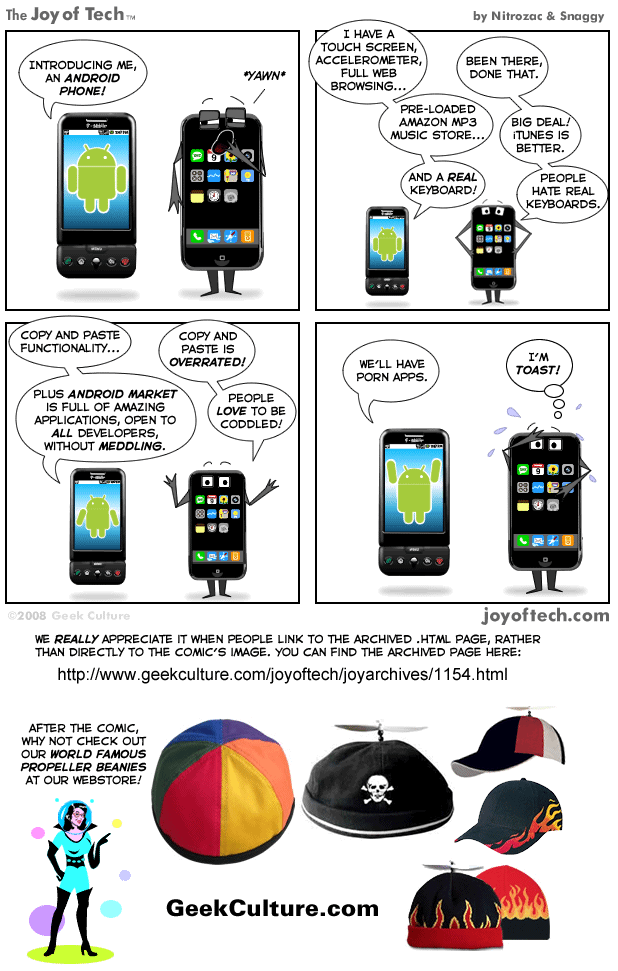
What Did Google Phone Say To The iPhone? (IMG)

Giz Explains: What's Good and Bad About Developing for Android and iPhone


Whether or not such a two-sided conflict will actually play out in the larger mobile-phone industry, today Android vs. iPhone is the battle raging in the mind of every fanboy, gadget geek—and software developer. Since it has all the right themes for a Tolkien-esque epic whose outcome largely rests with small, furry-footed but pure-hearted creatures—developers—we asked the developers of popular mobile apps such as Pandora, TuneWiki and Instinctiv Shuffle, mostly people working on both platforms, to tell us whether it's better to write for the no-strings-attached open Android or the more popular but catch-prone iPhone. Android may not be an overnight success, but iPhone had better watch its back.

Android: iPhone's Refugee Camp
While Android's open approach undoubtedly led some developers to pick it over the iPhone from the start, Apple's byzantine approval process and perhaps anti-competitive protection of its own apps—Podcaster and MailWrangler being two of the most prominent—have definitely driven some devs into Android's open arms, or at least made them stare longingly at it.

One such dev was the maker of the ridiculously popular Instictiv Shuffle app for jailbroken iPhones. Currently, iPhone apps aren't allowed to touch a user's music or iTunes functionality in any way. Instinctiv CEO Justin Smithline told us that "the minute we found out about the restrictions of the SDK...we started up an Android effort." Nevertheless it was clear in our interview that they loved the iPhone platform, using the word "amazing" more than once to talk about it.

Free But Not Equal
One of the original dustups around Android was that the 50 finalists in the Android Developer Challenge received early, privileged access to SDK updates that the rest of the developer community didn't get. While it makes sense that Google would want to fast-track Android's potential killer apps in time for the launch, it also goes against Android's atmosphere of openness.

It seems like there is some favoritism—whether it's toward specific devs or just toward the best apps is uncertain. TuneWiki is a finalist and one of Android's 10 most exciting apps. Amidst complaints about the lack of updates to Android's SDK until the recent 0.9 release and Google's secrecy, TuneWiki CEO Amnon Sarig told us that "I cannot say good enough things to say how [Google] treated us. They gave us whatever we wanted. They want us to succeed."

Since TuneWiki looks like it'll be a fantastic app, it's hard to argue with this—why shouldn't Google devote the most resources to the best and brightest, the stuff that'll make its platform shine? Logically, it should, given how much of the platform's success ultimately lies in the hands of developers. Depending on how you see Android's raison d'tre, that might be deeply troubling philosophically, on the other hand.

Nuts and Bolts
One thing that every developer we talked to pretty much agreed about is that coding for Android is not exactly warm robotic apple pie. While it's commonly assumed that Android development is done using run-of-the-mill Java, the developer of BreadCrumbz—a very cool image-based navigation app that's one of the 50 finalists, told us that the Android framework is actually "very different" from a regular Java stack, so that even "experienced Java developers still need to learn." TuneWiki's devs agreed that there's a learning curve, but both said that since it's still Java at the end of the day, it's a short one.

Instinctiv was more down on Android Java, compared to iPhone OS X, when it came to porting their app. When we talked to them before the release of the 0.9 SDK, they said that "Android is a mobile OS unlike the iPhone system, which is really kind of a desktop OS." Because of Java, they lamented that it'll be hard for Instinctiv Shuffle to do any really heavy lifting without bogging the system down, so they didn't think they'll be able to make it "as personalized" as the admittedly outlawed iPhone version.

Access to hardware appears to be much better than with the iPhone SDK, even though BreadCrumbz's Amos Yoffe says that Android "doesn't let you access the hardware directly, you go through Java APIs which are abstracted from the hardware." He still says that it's "pretty good." TuneWiki devs raved that "Android doesn't sandbox you like Apple does, so you have more flexibility." Apps run in the background just fine, battery drain issues aside. And conversely to this freedom, security policies and threats should be interesting (and maybe terrifying for nail-biter types) to watch develop, though at the start, Android seems to strike a good balance between security and freedom (insert current events political joke here).

Flexibility is a huge thing for Android. One of its strongest points—that it's going to run on a ton of phones with a rainbow of specs—might also prove to be one of its weak points, and perhaps the biggest challenge for developers. TuneWiki's Sarig said that since the Dev challenge only provided them with a single set of specs, no one's had to deal with the issue yet. It's definitely looming, however.

He admits that they're going to "have to scale back for less powerful handsets," though he doesn't know to what extent, since no one's seen the pile-of-rusted-bolts end of the Android hardware scale. BreadCrumbz's Yoffe says that "it's a bit early to say" if performance variance between handsets will be an issue, no one will really know "until we get our hands on real Android hardware." The G1's hodgepodge of interface methods—touchscreen, QWERTY and trackball—perhaps not so coincidentally gives developers a chance to experiment with multiple ways to interact with their app using a single device.

Android vs. iPhone: The Final Battle
Pandora CTO Tom Conrad, who famously said "I need Android like I need a hole in the head," actually takes a more measured approach to the platform war. He told us that "Generally, when I look at Android and the challenges we faced bringing Pandora to handsets," it doesn't seem to solve them. "It just adds another one to the mix."

Critical for Android's success is an easy-to-use app store and the killer apps to stock it. Conrad noted that while Pandora had been on a number of low-end phones for over two years, within 24 hours, their iPhone app had surpassed all of those users combined. They are currently taking a wait-and-see approach with Android, though he stressed that "absolutely, we want Pandora to be everywhere there are listeners." TuneWiki similarly wants to achieve multi-platform ubiquity, though they're much more juiced about both the iPhone and Android, saying, "We love them both."

Whoever wins, it looks like the carriers will lose. Every dev agreed that the iPhone sparked a revolution that is changing the way US carriers operate. Android is a part of that now, and the two, even locked in competition, will push that revolution further. In that sense, at least, we all win something.
Read More: Unlocking the T-Mobile G1: The Definitive Word , Why Android Is Bad For Business , How Many Google Phone Engineers Does It Take to Tell the Time? , T-Mobile Restricting 3G Data Usage to 1GB a Month Without Penalty